Ethereum Crypto Presale & New ETH Ecosystem Tokens
Understand where an Ethereum crypto presale actually deploys across mainnet and its surrounding Layer 2 ecosystem.
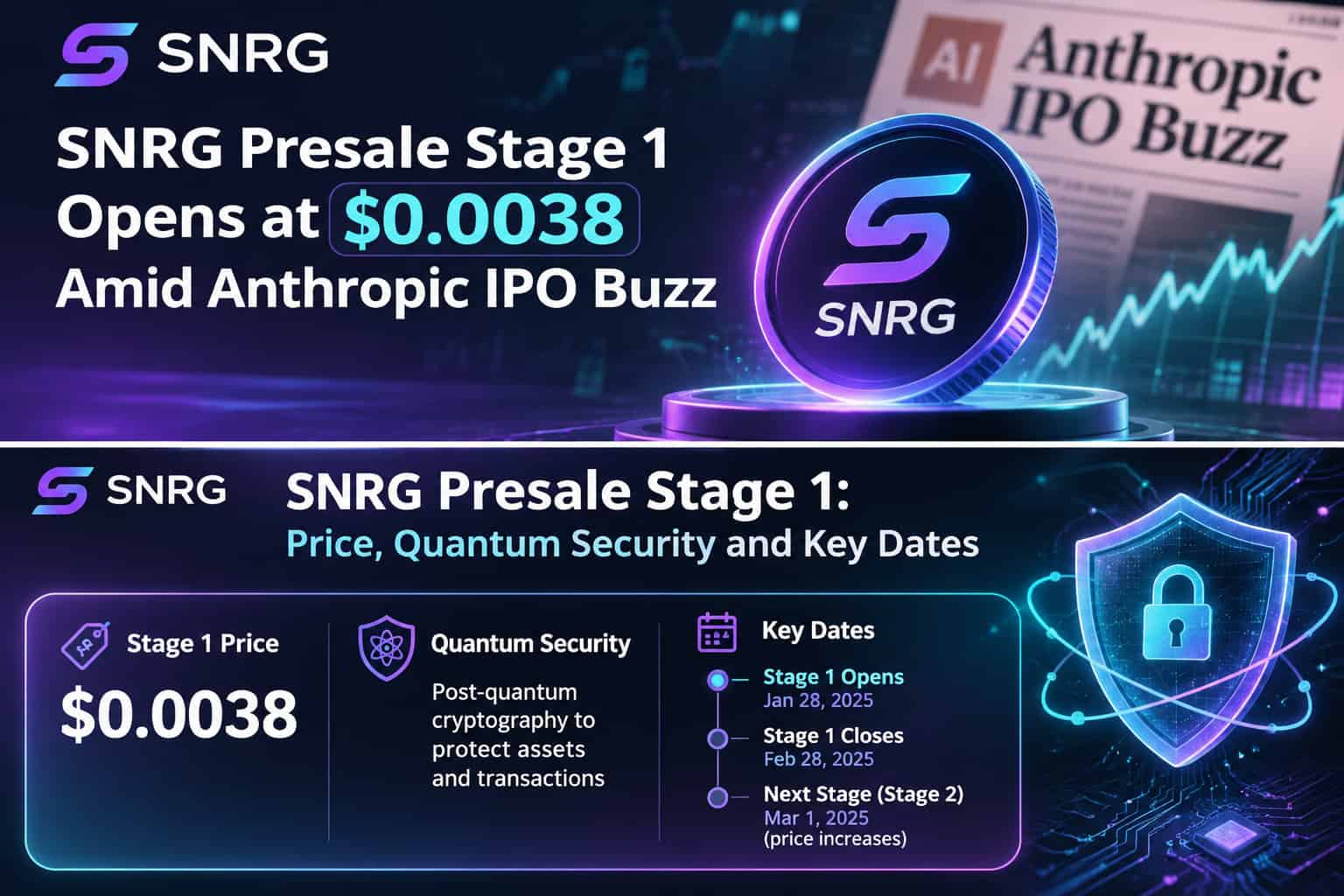
SNRG Presale Stage 1: Price, Quantum Security and Key Dates
Deployment Location Matters More Here Than on Almost Any Other Chain
An Ethereum crypto presale claim needs one specific clarification before anything else: does the project deploy directly on Ethereum mainnet, or on one of the dozens of Layer 2 rollups that settle to it, such as Arbitrum, Optimism or Base? Mainnet gas fees remain meaningfully higher than most L2s even after 2025's data-cost improvements, and a genuinely retail-facing presale is far more likely to launch on an L2 for cost reasons, while citing "Ethereum" as the security and brand association. Confirm the actual deployment chain before assuming mainnet-level security assumptions or mainnet-level gas costs apply.
Fusaka Changed the Cost Structure for L2s Specifically
The Fusaka upgrade, live since 3 December 2025, integrated Peer Data Availability Sampling, stabilising L2 data costs and helping the broader rollup ecosystem surpass 100,000 transactions per second in aggregate. This is a mainnet-level upgrade whose primary beneficiaries are the Layer 2 chains built on top of Ethereum, not mainnet transactions directly. A presale citing Fusaka as a reason its own L2-based token will be cheaper to use is describing a genuine, verifiable improvement, provided the project actually deploys on an L2 benefiting from it.
Where Liquidity Actually Concentrates
Ethereum holds an estimated 65% to 68% of global DeFi total value locked and a similarly dominant share of tokenised real-world assets, around 65%, making it by far the deepest liquidity environment in crypto for any asset that can access it. Total value secured across the Layer 2 ecosystem alone breached $40 billion in early 2026. This scale is real and unmatched. It does not automatically extend to a specific new token, which still needs its own bootstrapped liquidity pool regardless of how deep the surrounding ecosystem is.
Mainnet Activity Has Specialised, Not Declined
Mainnet daily active addresses reached a record 1.2 million in January 2026 even as more transactional activity has migrated to L2s, reflecting a division of labour rather than mainnet abandonment: mainnet increasingly serves as settlement and high-value activity, while L2s handle high-frequency, lower-value transactions. A presale project should specify which layer of this division it actually occupies, since the cost, speed and audit environment differ substantially between mainnet and its L2s.
Staking and Institutional Flows Concern ETH, Not Others
Approximately 29% to 30% of ETH's total supply, roughly 35.86 million ETH, is staked across more than 1.1 million active validators, and spot ETH ETFs had accumulated over $11 billion to $17 billion in net inflows by early 2026, with BlackRock's staking-enabled ETHB launching on Nasdaq in March 2026. These are genuine, checkable institutional developments concerning ETH as an asset. A presale citing this institutional momentum as validation for its own separate token is applying ETH's specific fundamentals to an unrelated asset.
The "Ultrasound Money" Narrative Has Paused, Not Reversed Into Inflation Panic
Ethereum's issuance settled into a modest 0.74% annualised inflation rate as of early 2026 as execution revenue increasingly migrates to rollups rather than mainnet, a shift in where value accrues rather than a breakdown of the network's underlying economics. A presale project benchmarking its own token against ETH's monetary policy should understand this nuance rather than treating either the deflationary or inflationary framing as settled fact.
Which Categories Are Most Active in 2026
Real-world asset tokenisation and institutional DeFi lead mainnet-adjacent activity, reflecting Ethereum's dominant RWA share, alongside restaking protocols like EigenLayer letting staked ETH secure additional networks. Real-world asset presales here often cite Ethereum's institutional custody advantage specifically.
Due Diligence Specific to This Ecosystem
Confirm whether a contract deploys on mainnet or a specific L2, since gas costs, audit conventions and finality differ substantially. Verify any citation of Ethereum's TVL or RWA dominance applies to the ecosystem broadly, not to the specific new token being sold. Check whether restaking-related yield claims involve genuine EigenLayer integration or unrelated terminology. For a comparison against the largest single Ethereum L2 by most TVL measures, see our Arbitrum crypto presale pages.
Glossary
- Fusaka: Ethereum's December 2025 upgrade integrating PeerDAS, stabilising data availability costs for the Layer 2 ecosystem.
- Restaking: Using already-staked ETH to simultaneously secure additional protocols, earning extra yield through mechanisms like EigenLayer.
- Total Value Secured: A metric measuring all value secured across Ethereum's Layer 2 ecosystem, distinct from DeFi-specific TVL.
- Blob: A data structure introduced for Layer 2 rollups to post data cheaply to Ethereum mainnet, central to reducing L2 transaction costs.
Disclaimer
This page is for informational purposes only and does not constitute financial or investment advice. Presale participation carries significant risk, including total loss of contributed funds. Verify the exact deployment chain and contract address on Etherscan or the relevant L2 explorer before contributing to any project.